

Background: Coffee quality is strongly influenced by origin-related factors, or terroir, which shape chemical composition and sensory characteristics. In the specialty coffee sector, where authenticity, traceability, and flavour distinctiveness drive value, understanding the molecular basis of sensory attributes, particularly perceived intensity, is essential. Methods: This study combined analytical chemistry and explainable artificial intelligence to explore relationships between volatile composition, coffee origin, and sensory intensity. Roasted and ground single-origin coffees from five provenances were analysed using headspace solid-phase microextraction coupled with gas chromatography–mass spectrometry (HS-SPME/GC–MS). A Support Vector Machine (SVM) classifier discriminated coffee origins based on volatile profile, and SHapley Additive exPlanations (SHAP) identified key compounds. Ridge Regression (RR) was applied to predict sensory intensity values assigned by an expert panel. Results: The SVM model classified coffee origins with 91% accuracy, and SHAP analysis highlighted the volatiles most responsible for differentiation. RR predicted sensory intensity with R2 = 0.88 and RMSE = 0.38, linking molecular profiles with panel-assigned intensity scores. Conclusions: This approach connects molecular profile with packaging-declared aroma intensity, offering an indirect yet informative link to sensory perception and illustrating the potential of data-driven methods in sensory science. Overall, the proposed explainable AI approach provides a transparent and reproducible connection between chemical composition, sensory traits, and perceived quality. This strategy supports more objective and traceable quality assessment systems, aligning analytical precision with sensory expertise, which is an essential step toward the evolution of quality control in industrial applications.
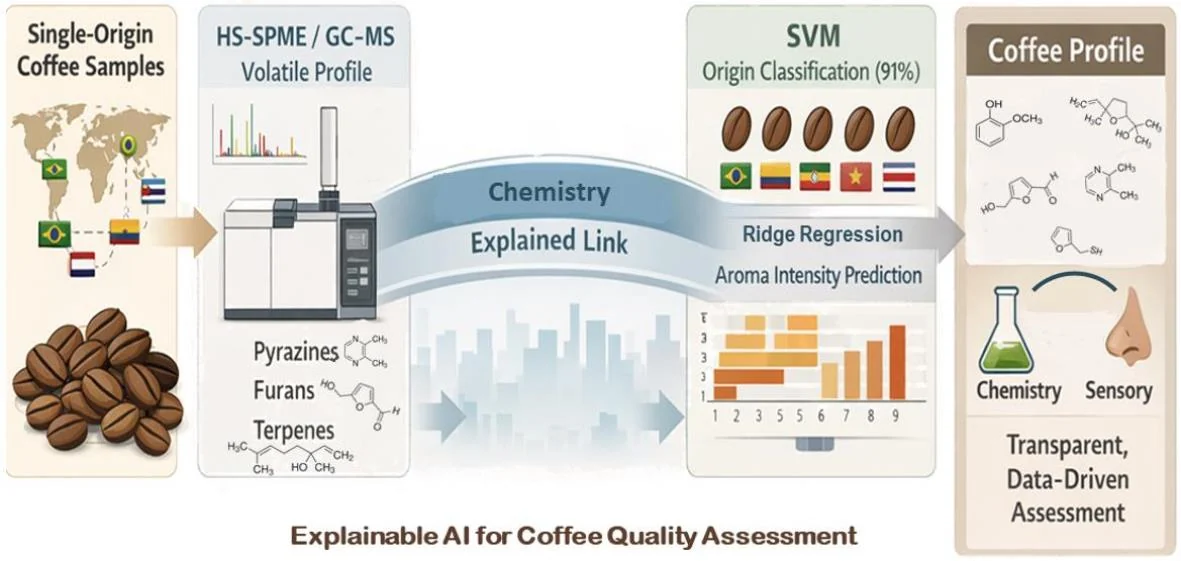

🚀 EVOQUE – Horizon Europe Collaborative project’s latest publication by partners Universita di Torino and IllyCaffé. 📚 Our new paper, in Foods (MDPI), exploring the use of explainable artificial intelligence (XAI) to assess coffee origin and aroma characteristics.
The study combines chemical analysis using gas chromatography–mass spectrometry (GC–MS) with machine learning techniques to investigate the chemical fingerprints of coffee samples from five countries.
Key results include:
The research demonstrates how combining analytical chemistry and explainable AI can support more transparent, data-driven approaches to food quality assessment and control.
Congratulations EVOQUE partners on this publication!
📖 Read the paper: here or download the PDF.
#ProjectEvoque #PhotoacousticSpectroscopy #Innovation #TechResearch #GasTurbulence