

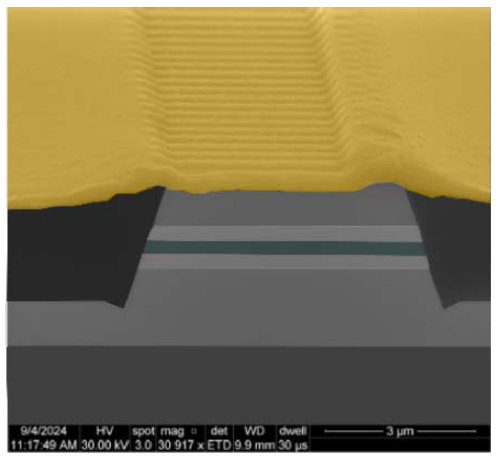
In this work, single-mode, interband cascade lasers (ICLs) incorporating a metal top-surface distributed feedback (DFB) grating are successfully demonstrated on both native GaSb and lattice-mismatched GaAs substrates. To the best of our knowledge, this work represents the first demonstration of single-mode DFB operation near 4.6 µm from an ICL grown on a lattice-mismatched GaAs substrate. First-order gratings etched into the upper InAs/AlSb cladding are integrated with 6-µm-wide and 2-mm-long ridge waveguides. ICLs are studied under pulsed operation up to 60°C. Comparable performance is achieved for both substrate platforms, with threshold current densities of 500 A/cm2 at 20 °C. Single mode operation with side mode suppression ratio (SMSR) exceeding 20 dB is obtained for temperatures above 30°C. The devices emit at 4.6 µm, a wavelength relevant for carbon monoxide (CO) spectroscopy.

Advancing Mid-Infrared Laser Technology: New Research from the University of Montpellier
EVOQUE partners University of Montpellier and MirSENSE have published a new scientific paper in Optics Express, presenting advances in single-mode interband cascade lasers (ICLs) emitting at 4.6 µm.
The study, entitled “Single-mode, distributed feedback interband cascade lasers grown on GaSb and GaAs substrates, emitting at 4.6 µm”, investigates the development of mid-infrared semiconductor lasers using gallium antimonide (GaSb) and gallium arsenide (GaAs) substrates.
By combining interband cascade laser technology with distributed feedback (DFB) structures, the research addresses the generation of precise, single-mode mid-infrared emission.
These developments contribute to advancing compact and wavelength-selective laser sources, with potential applications in gas sensing, chemical detection and environmental monitoring.
👏 Congratulations to the partners on this publication!
📖 Read the paper: here or download the PDF.
#ProjectEvoque #PhotoacousticSpectroscopy #Innovation #TechResearch #GasTurbulence